

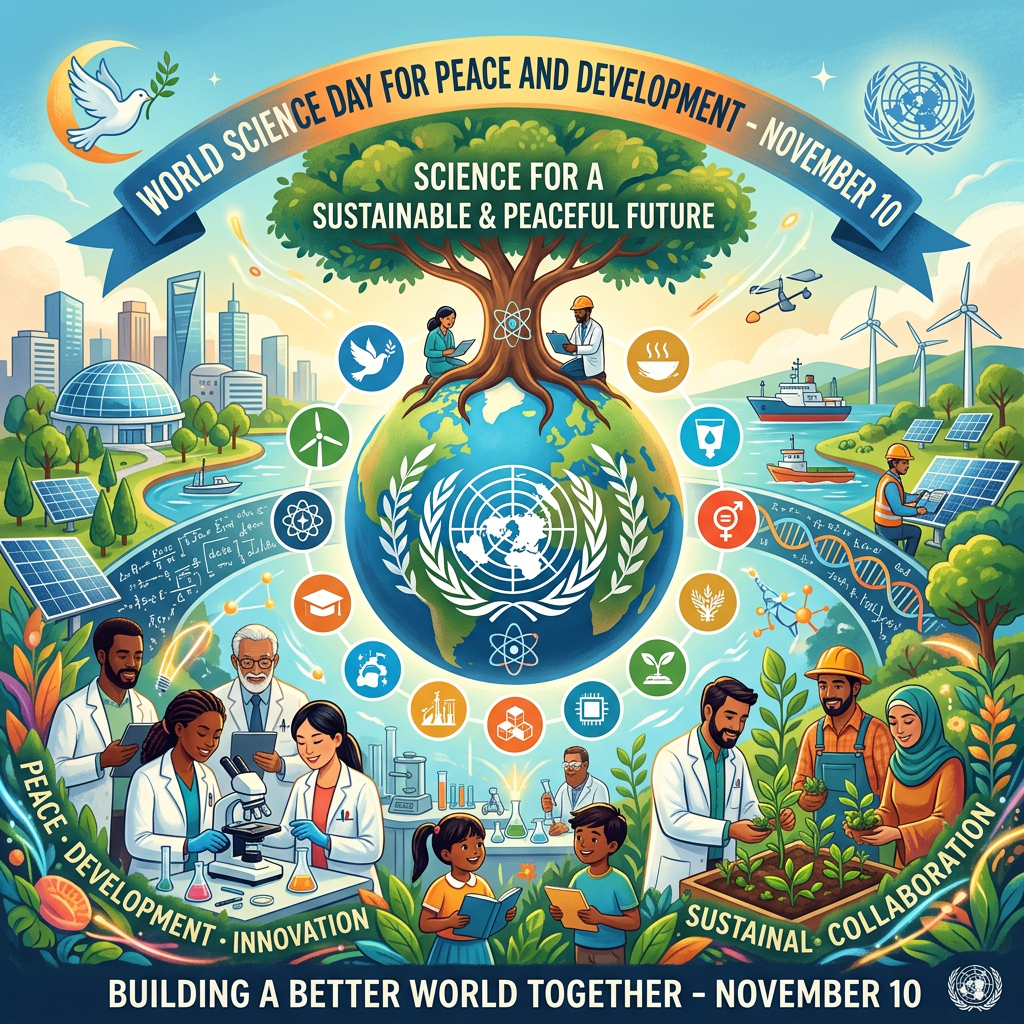
World Science Day for Peace and Development is an annual observance held on 10 November. Established by UNESCO, it draws attention to the ways science can contribute to peaceful, inclusive and sustainable societies. Rather than treating scientific discovery as separate from everyday life, the day encourages people to consider how research, evidence and innovation affect communities and the choices that shape their future.
Table of Contents
World Science Day for Peace and Development – 10 november
Science
Peace
Development
Three keywords
All related
To world issues
Improve science
for peace and development
Is the message here
Let us explore how the observance began, why UNESCO established it and how its themes have developed. We also consider the practical role of science in supporting peace and sustainable development, the value of public participation, and ways the annual event can encourage action. Together, these topics show why the day is more than a celebration of discoveries: it is a prompt to connect science with the needs, rights and aspirations of people everywhere.
At its centre is the connection between scientific progress and public needs. Science can help address challenges such as climate change, public health, food security and access to clean water, but its benefits are not automatic. They depend on whether knowledge is shared fairly, whether research responds to local priorities and whether people can participate in decisions that affect them. The observance therefore also highlights the importance of scientific literacy and public engagement.
The day links science with human rights and responsible decision-making. Access to scientific knowledge and the benefits of progress are important considerations, while researchers and policymakers must weigh potential risks, ethical questions and long-term consequences. Open discussion can help build trust, challenge misinformation and ensure that evidence informs public policy without replacing democratic debate.
International cooperation is another central theme. Many problems cross national borders, and progress often depends on researchers, institutions and governments working together, sharing knowledge and building capacity. World Science Day provides an occasion to recognize these efforts and consider how cooperation can be strengthened, including where resources and opportunities are unevenly distributed.
The origins of World Science Day for Peace and Development lie in the 1999 World Conference on Science, held in Budapest, Hungary. Organized by UNESCO and the International Council for Science, the conference brought together governments, scientists, and representatives of scientific organizations to examine how research could respond to society’s needs. Its discussions addressed not only scientific progress, but also the responsibilities that come with producing and applying knowledge.
Participants emphasized that science and society are closely connected. Scientific advances can support health, education, environmental protection, and economic opportunity, but their benefits are not automatic or evenly shared. The conference therefore called for stronger links between researchers and the public, wider access to scientific knowledge, and greater attention to ethical and social considerations. The resulting Declaration on Science and the Use of Scientific Knowledge and the Science Agenda—Framework for Action set out commitments to make science more inclusive and useful for peaceful development.
Building on those commitments, UNESCO proclaimed World Science Day for Peace and Development in 2001. The first observance followed on November 10, 2002, establishing an annual opportunity to highlight science’s role in addressing shared challenges and promoting cooperation. The date gives governments, schools, scientific institutions, and communities a recurring occasion to discuss how research is conducted, communicated, and applied.
The initiative was designed to do more than celebrate discoveries. It encourages public engagement with science and supports efforts to make scientific information accessible beyond specialist communities. It also underscores the importance of international collaboration and responsible use of research, so that knowledge can contribute to peace, human well-being, and sustainable progress. In this way, the observance carries forward the Budapest conference’s central idea: science serves society best when people can participate in its benefits and when scientific work is guided by public needs. Its annual recognition connects those principles to practical conversations about trust, inclusion, and development around the world.
Science matters for peace and development because many of the challenges societies face cross national borders and affect people regardless of where they live. Research can improve the prevention and treatment of disease, strengthen food systems, and help communities manage limited supplies of clean water. Climate science informs efforts to reduce emissions and prepare for changing conditions, while research into energy can support more reliable and sustainable power. These contributions are most effective when scientific knowledge is connected to practical needs and shared with the people and institutions responsible for responding.
Evidence-informed policies can help governments assess risks, compare possible solutions, and direct resources where they are most useful. Reliable data can improve disaster preparedness by supporting early warnings, emergency planning, and recovery. In education, scientific literacy gives people tools to assess information and participate in decisions that shape their lives. Research and innovation can also create jobs, improve productivity, and support economic and social development. When scientists, policymakers, communities, and businesses exchange knowledge openly, they can identify common interests and coordinate responses. Cooperation across borders is particularly important when outbreaks, environmental pressures, or disasters cannot be contained within one country.
However, science does not automatically lead to peaceful or fair outcomes. Technologies may widen existing inequalities if their benefits are inaccessible, or cause harm when they are deployed without adequate safeguards. Ethical oversight, public accountability, and meaningful participation can help ensure that research respects human rights and considers potential consequences. Inclusion matters: women, disadvantaged communities, and regions with fewer research resources should have opportunities to contribute to scientific work and share in its gains. Equitable access to knowledge, education, infrastructure, and useful technologies is also essential. Responsible science requires openness alongside protections for privacy and safety. By combining evidence with ethical judgment and broad cooperation, societies can use scientific progress to reduce risks, build trust, and advance development more fairly.
World Science Day for Peace and Development is observed in varied ways, bringing scientific ideas beyond laboratories and universities and into public life. Universities, museums, schools, and community organizations may host public lectures, panel discussions, science exhibitions, or demonstrations that explain research and its relevance to everyday concerns. Classrooms can mark the occasion with experiments, debates, or projects that invite students to ask questions and assess evidence. Community discussions create opportunities for residents, researchers, and local decision-makers to consider shared challenges, from public health and clean water to climate risks and food security. Campaigns and media activities can also connect scientists with wider audiences.
Each year, a chosen theme can focus attention on a particular scientific priority or global concern. Themes help organizers shape events and encourage discussion around timely issues, while the day’s broader purposes remain central: recognizing science as a resource for peace and sustainable development, supporting access to knowledge, and strengthening trust between science and society. A theme should therefore open a useful conversation rather than narrow the day to a single topic. Connecting global priorities with local experience can make observances more relevant and show how scientific cooperation contributes to communities’ wellbeing.
Participation does not require specialist training or a large event. Students can explore trustworthy science resources, visit an exhibition, or prepare questions for a researcher. Educators can include evidence-based activities in lessons and make space for respectful debate. Scientists can explain their work in clear, accessible language, listen to public concerns, and communicate uncertainty responsibly. Community members can discuss local challenges using reliable evidence, invite experts to share perspectives, and support inclusive science education so that people of different backgrounds can take part. Sharing accurate information through school, workplace, or community channels is another practical contribution. These actions help make science more accessible and connect knowledge with decisions that affect daily life.
More readings
For creative and inventive ones


Thank you for reading, shares and comments!
✨ Comment Policy ✨
We welcome thoughtful, kind, and constructive comments that contribute to meaningful conversations.
Please note:
- Promotional links and unsolicited offers will be removed.
- Spam, irrelevant content, or self-promotion without prior permission will not be published.
- We value quality engagement over quantity — thank you for helping us keep this a respectful and inspiring space!


