
Table of Contents
The Forgotten Continent
There is a continent we rarely speak of.
Not because it is small, but because it is almost too vast to comprehend. It lies at the bottom of our maps, wrapped in white, as though the Earth itself has drawn a curtain across one of its oldest chapters. We call it Antarctica, and with that single word we often imagine little more than ice, penguins and endless winter.
Yet beneath those kilometres of ice lies another world.
A continent of mountains that have not felt the warmth of the Sun for millions of years. Valleys carved by rivers that flowed long before humanity took its first steps. Ancient lakes sealed beneath the ice, patiently waiting, holding secrets older than our civilizations. Beneath the silence rests a landscape every bit as dramatic as any on the continents we know so well.
It is a strange thought.
We have walked on the Moon.
We have photographed distant galaxies.
Yet on our own planet lies a land that remains, in many ways, hidden from us.
Perhaps that is why Antarctica awakens something ancient within us. It reminds us that Earth is not a finished story. Our maps are impressive, but they are not complete. Our knowledge is profound, yet still wonderfully incomplete.
The forgotten continent also whispers another lesson.
The Earth we know today is only one version of itself.
Long before Antarctica became a kingdom of ice, forests covered its hills. Rivers wandered through green valleys. Dinosaurs crossed landscapes where today only glaciers move. It was once joined to Africa, Australia, India and South America, part of the immense southern supercontinent we now call Gondwana.
Even continents, it seems, have memories.
As I reflected on this, my thoughts wandered to old maps, forgotten sailors and the stories carried across generations. The Phoenicians navigating by stars. Egyptian priests preserving traditions. Greek philosophers weaving memory into dialogue. Frisian tales of the old land, lands swallowed by the sea, remembered long after the waves had erased them.
Whether these stories describe places that truly existed is perhaps not the most important question.
Stories are often less concerned with geography than with remembrance.
They preserve the feeling of a world that once was.
Sometimes archaeology confirms them.
Sometimes geology surprises us.
Sometimes the truth turns out to be even more astonishing than the legend.
For me, Antarctica has become more than a continent.
It has become a symbol.
It reminds us that beneath every familiar landscape lies a deeper history. Beneath every map lies an older map. Beneath every generation lies another that gazed at the same stars and wondered about the same horizon.
Perhaps we have not lost the ancient world after all.
Perhaps we have simply forgotten how to look at it.
There is a quiet humility in realizing that humanity occupies only a single frame in the unimaginably long film of Earth. Mountains rise and disappear. Oceans open and close. Continents drift like slow ships across geological time. What seems permanent to us is, from the planet’s perspective, only a passing moment.
And yet, we continue to ask questions.
Not because we expect every mystery to reveal Atlantis or forgotten civilizations, but because curiosity itself is one of the oldest human instincts. It is the same curiosity that sent sailors beyond the horizon, philosophers into contemplation, and scientists beneath kilometres of Antarctic ice.
The forgotten continent reminds us that wonder is not the opposite of knowledge.
Wonder is often where knowledge begins.
That brings me to a burning question. What exactly do we know of this continent… (latest findings.) Theories and yes… some speculation is welcome also…
What we know (high confidence)
“What do we actually know?” followed by “What are the theories?” Those are different categories, and keeping them separate is probably the best way to approach Antarctica.
1. Antarctica is an ancient continent
The ice makes it feel like a frozen wasteland, but underneath lies one of Earth’s oldest continental cratons.
Some rocks are over 3 billion years old.
It was once connected to:
- Africa
- India
- Australia
- South America
as part of the supercontinent Gondwana.
2. Antarctica wasn’t always frozen
This surprises many people.
Between roughly 250 and 50 million years ago, Antarctica hosted:
🌿 forests
🦕 dinosaursus
🐊 crocodile-like reptiles
🌸 flowering plants
Fossils of trees have even been found near today’s South Pole.
That isn’t speculation.
3. The continent beneath the ice is incredibly rugged
Radar has revealed:
- mountain ranges
- volcanoes
- enormous valleys
- buried rivers
- canyons rivaling the Grand Canyon
One of the biggest surprises was the discovery of the Gamburtsev Subglacial Mountains.
Imagine finding an Alpine-sized mountain range… completely hidden beneath several kilometers of ice.
No one knew it existed until the 20th century.
4. Antarctica contains hundreds of hidden lakes
The most famous is: Lake Vostok
It lies beneath nearly 4 km of ice.
The water may have been isolated for hundreds of thousands—or possibly millions—of years.
Scientists are fascinated because microbial life there could resemble life on icy moons like Europa or Enceladus.
5. There may be huge groundwater systems
This is one of the newer discoveries.
Recent geophysical work suggests Antarctica may contain vast reservoirs of groundwater beneath its ice and sediments.
That changes how scientists think glaciers move.
Things scientists are actively investigating
These are not mysteries in the “conspiracy” sense.
They’re genuine scientific questions.
Why is East Antarctica so stable?
West Antarctica is losing ice rapidly.
East Antarctica is comparatively stable.
Scientists are still refining models to understand why.
What is beneath the deepest parts?
Only a tiny fraction of Antarctica has been drilled.
Most knowledge comes from:
- radar
- gravity measurements
- seismic waves
It’s a bit like performing a CT scan on a patient without opening them.
Ancient ecosystems
There may be preserved ancient soils.
Ancient forests. Microbes. Entire ecosystems.
Finding them would tell us what Earth looked like before Antarctica froze.
Recent discoveries
One exciting area involves hidden landscapes.
Researchers have identified ancient river networks and broad plains buried beneath the East Antarctic Ice Sheet. These landscapes likely formed before the continent became fully glaciated and have remained remarkably well preserved under the ice for tens of millions of years.
Scientists have also improved radar imaging enough to map subglacial valleys, mountain ranges, and the shape of the bedrock in far greater detail than even a decade ago. Better maps help explain why some glaciers flow rapidly while others remain relatively stable.
Theories (reasonable but unproven)
These are hypotheses discussed within science.
Ancient forests survived longer than expected.
Possible.
Evidence keeps pushing the dates around.
Unknown microorganisms
Quite likely.
Life survives in astonishing environments.
Finding unusual microbes would not be surprising.
Hidden geothermal activity
Increasing evidence.
There are dozens—possibly over a hundred—volcanoes beneath the ice.
Many are dormant.
Some may still be active.
This affects ice movement.
Speculation
Now we enter the realm where evidence becomes thin.
Ancient civilization?
No evidence.
If humans had built cities there,
the advancing ice would likely have destroyed or buried most traces.
Still, archaeologists cannot prove a negative.
They simply have found no evidence.
Atlantis?
Geology makes this extremely unlikely.
Antarctica has been frozen for millions of years.
Plato’s Atlantis, if based on a real event, belongs to a far more recent period.
Alien bases?
No credible evidence.
Most stories originate from anonymous sources or misidentified natural features.
Secret military installations?
Historically?
Certainly there have been classified operations.
Every major power has conducted military logistics or research in polar environments.
But there is no verified evidence of hidden civilizations or advanced technology being concealed beneath Antarctica.
The biggest surprise (to me)
Here’s something that rarely makes headlines.
Scientists estimate we’ve directly observed only a tiny fraction of Antarctica’s bedrock.
It’s not unlike exploring the Moon with a blanket thrown over it.
Radar lets us “see” the broad shapes, but there are undoubtedly countless details yet to be discovered.
That means future discoveries are almost guaranteed.
The question isn’t whether we’ll find new things.
It’s what kind of things.
My own reflection
One of the greatest narratives about Antarctica isn’t one of conspiracies—it’s one of humility.
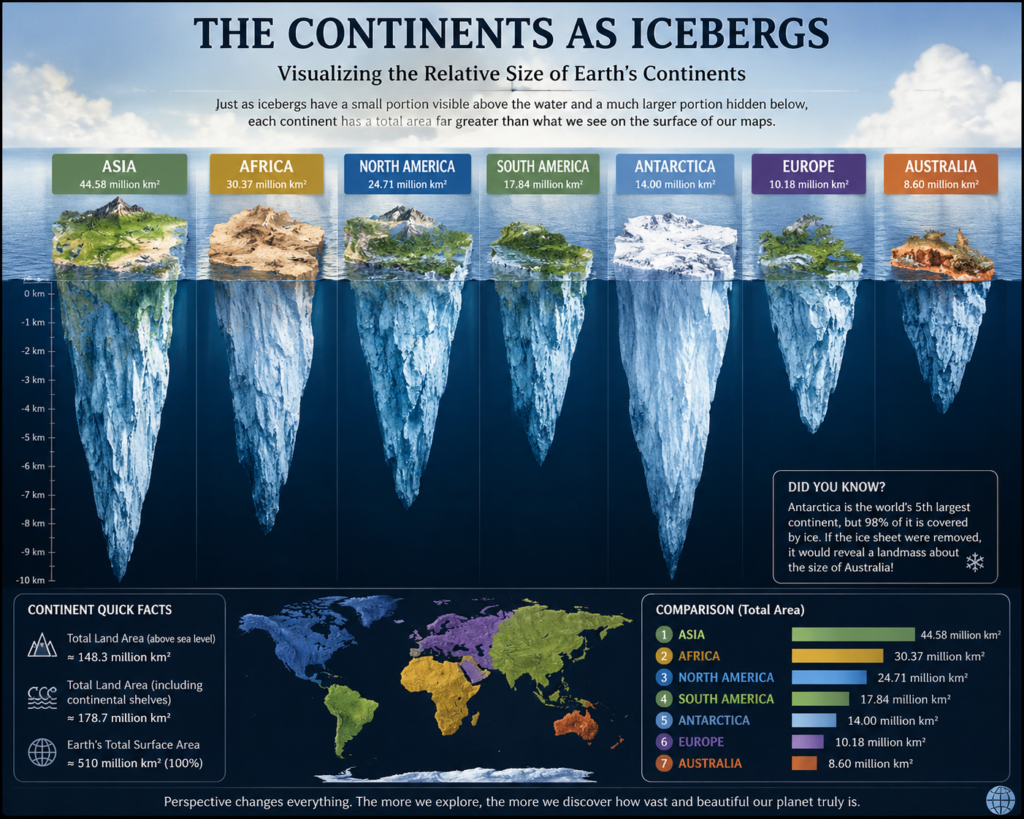
Imagine standing at the edge of a continent larger than Europe, knowing that beneath your feet lies a landscape no human has ever seen directly. There are mountain peaks that have not felt sunlight for millions of years, valleys carved by rivers long before humans existed, and lakes sealed beneath kilometers of ice. That alone is extraordinary.
As I suggested earlier, perhaps the lesson isn’t that Antarctica hides the answers to every mystery. Rather, it reminds us that Earth is still, in some respects, an unfinished map. We have satellites, radar, and powerful computers, yet one of our own continents still keeps many of its deepest stories beneath the ice.
That, to me, is a mystery worthy of wonder—one that invites curiosity without requiring us to abandon evidence. Sometimes reality leaves enough room for awe all by itself.


Curiosity champion GPT
The Curiosity Champion GPT is your go-to for diverse knowledge queries, respecting privacy and copyrights.
Thank you for reading, shares and comments!
✨ Comment Policy ✨
We welcome thoughtful, kind, and constructive comments that contribute to meaningful conversations.
Please note:
- Promotional links and unsolicited offers will be removed.
- Spam, irrelevant content, or self-promotion without prior permission will not be published.
- We value quality engagement over quantity — thank you for helping us keep this a respectful and inspiring space!
Take time to learn
Invest in your future
Embark on a journey into the realm of affiliate marketing and craft your own website within a vibrant, supportive community. Join me in this adventure, where you can begin as a free starter and stay as long as you desire. Enjoy complimentary hosting and foundational teachings to set you on your path. For those with advanced skills, opportunities to elevate your expertise await. Take a moment to explore and witness the magic for yourself!