

Table of Contents
Mustard Seed
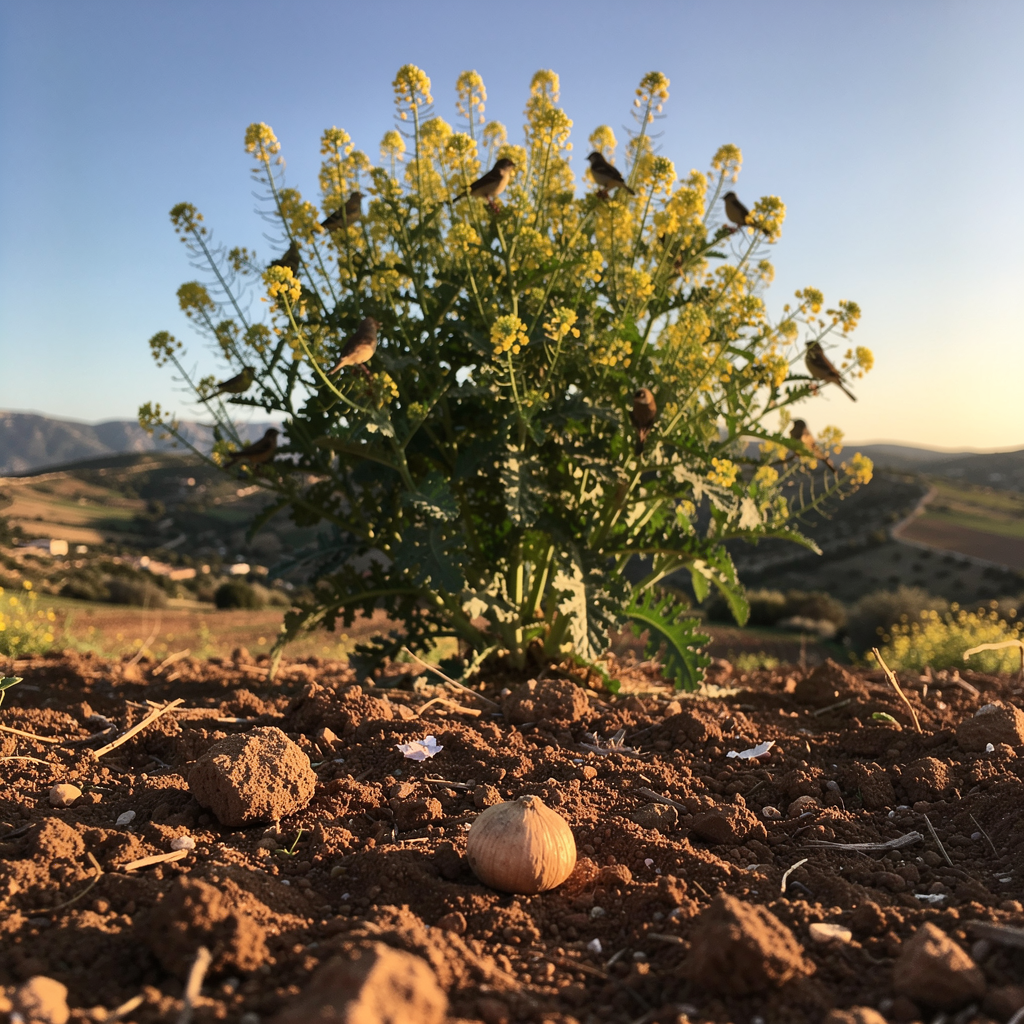
When Jesus speaks of the mustard seed, he is probably not referring to the mild yellow mustard (Sinapis alba) familiar from many modern condiments. He is drawing on a pungent, fast-growing mustard plant familiar in the eastern Mediterranean—most likely black mustard (Brassica nigra), although scholars cannot identify the biblical plant with absolute certainty.
🌱 What was the biblical mustard?
The Greek word in the New Testament is σίναπι (sinapi), meaning mustard. It appears particularly in Jesus’ teaching:
- Matthew 13:31–32 — the mustard seed grows into something remarkably large.
- Mark 4:30–32 — it becomes large enough for birds to shelter in its branches/shade.
- Luke 13:18–19 — the seed is planted and grows dramatically.
- Matthew 17:20 / Luke 17:6 — a mustard seed represents something proverbially tiny: even very small faith can have extraordinary consequences.
Black mustard fits the imagery rather well. It is an annual member of the cabbage family (Brassicaceae). Under favorable conditions it can become exceptionally vigorous and reach roughly 2–3 m (6–10 ft), sometimes approaching the appearance of a small shrub.
So when some translations say that it becomes a “tree,” we shouldn’t picture an olive, cedar, or oak. Jesus’ image is intentionally striking: a minute seed produces an unexpectedly enormous herbaceous plant.
Is it really “the smallest seed“?
Jesus’ expression should be understood in its ordinary agricultural setting, rather than as a modern worldwide botanical claim.
Mustard seeds are very small—roughly 1–2 mm—but they aren’t literally the smallest seeds known to botany. Orchid seeds, for example, are vastly smaller.
In ancient Jewish and Mediterranean speech, however, the mustard seed could function proverbially as an example of something extremely small. Thus “a mustard seed” works rather like our expression “a speck.”
That makes the contrast in the parable the important point:
tiny beginning → astonishing growth → shelter for others.
There’s probably another biblical echo in the birds finding shelter. The Old Testament uses a great tree sheltering birds as imagery for a great kingdom—for example Ezekiel 17:22–24 and Daniel 4:10–12. Jesus takes imagery associated with imposing kingdoms and attaches it to something as unimpressive as a mustard seed.
🧬 What makes mustard botanically interesting?
Mustard belongs to the same family as cabbage, kale, broccoli, turnips and radishes. These plants contain compounds called glucosinolates.
A dry intact mustard seed isn’t maximally pungent. When the seed is crushed and mixed with water, enzymes—particularly myrosinase—break down glucosinolates and produce pungent compounds.
In black mustard, an important product is allyl isothiocyanate.
That’s the sharp sensation that travels into your nose when you eat strong mustard or horseradish.
So ancient people crushing mustard seeds weren’t merely mechanically releasing a flavor already sitting there. They were initiating a little piece of plant chemistry.
🏺 What might ancient mustard have tasted like?
It probably wasn’t much like bright-yellow American mustard.
Ancient Mediterranean mustard preparations could have been much simpler: crushed mustard seed + liquid, with ingredients such as vinegar, wine/must, salt, oil, or honey added according to period and region.
The Romans definitely prepared mustard condiments. The Latin connection is preserved in the English word mustard, associated historically with mustum (“must,” freshly pressed grape juice) and pungent mustard preparations.
A historically inspired—not a claim to reproduce a specific biblical recipe exactly—version is:
Grind 2 tablespoons of black mustard seeds. Moisten them with a little cool water and leave briefly for the pungency to develop. Mix in 1–2 tablespoons of wine vinegar or grape must, a pinch of salt, and a little honey if desired. Grind until it becomes a coarse paste.
That would give you something earthier, hotter, grainier and considerably more aggressive than standard American yellow mustard.
And there’s an important distinction: the Bible mentions mustard as a familiar plant and proverbial seed; it does not give us a mustard recipe. Ancient recipes come from the broader Greek and Roman culinary world rather than Scripture itself.
Biblical mustard vs. supermarket mustard
“Modern mustard” isn’t actually one plant. Several related species are used:
| Mustard | Botanical name | Seed | Character |
| Black mustard | Brassica nigra | dark brown/black | Very pungent; strong biblical candidate |
| Brown mustard | Brassica juncea | brown | Hot; widely used in Asian and modern mustards |
| White/yellow mustard | Sinapis alba | pale yellow | Generally milder; common in Western yellow mustard |
The familiar brilliant yellow color of American prepared mustard is also influenced by turmeric. So the condiment in a modern squeeze bottle shouldn’t determine the mental picture you bring to Jesus’ parables.
One of the most beautiful things about the mustard image is that Jesus chose something ordinary, agricultural, slightly unruly, and intensely alive. His listeners knew this wasn’t a majestic cedar seed. It was an insignificant-looking seed capable of producing a surprisingly conspicuous plant.
Have faith like a mustard seed!

Take time to learn
Invest in your future
Embark on a journey into the realm of affiliate marketing and craft your own website within a vibrant, supportive community. Join me in this adventure, where you can begin as a free starter and stay as long as you desire. Enjoy complimentary hosting and foundational teachings to set you on your path. For those with advanced skills, opportunities to elevate your expertise await. Take a moment to explore and witness the magic for yourself!